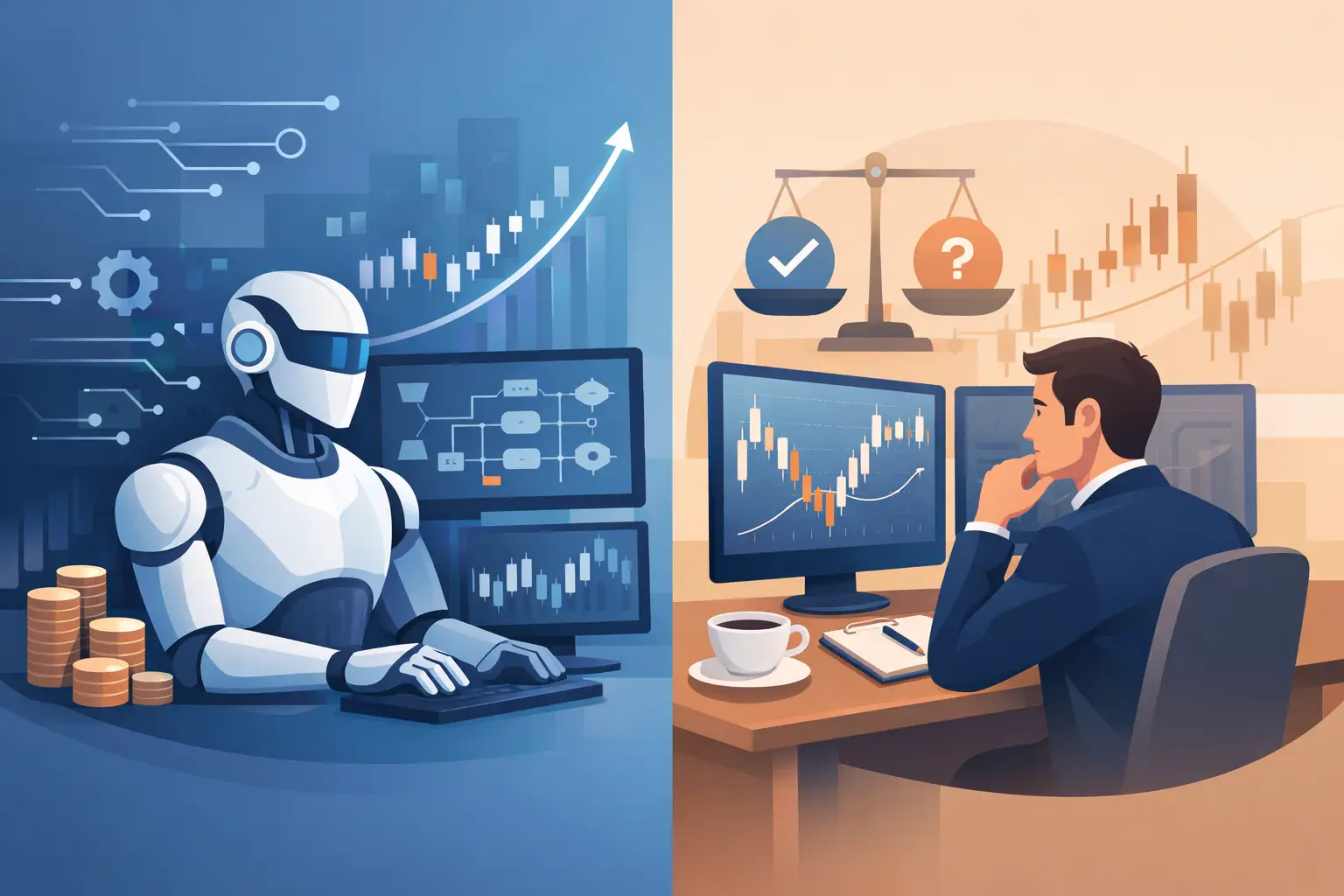
A trader takes the same setup five times in a week and gets five different executions. The chart did not change. The market structure did not change. What changed was the trader. That is the real starting point for algorithmic vs discretionary trading.
For serious traders, this is not a philosophical debate. It is a performance question. How much of your edge comes from objective rules, and how much depends on your real-time judgment? The answer affects consistency, drawdown control, scalability, and even which tools belong in your workflow.
What algorithmic vs discretionary trading really means
Algorithmic trading uses predefined rules to generate signals, manage entries, size positions, and in some cases execute trades automatically. Those rules can be simple or highly complex, but the core feature is the same: the decision logic is defined in advance.
Discretionary trading puts the final decision in the trader's hands. A discretionary trader may still use indicators, market internals, volume tools, or volatility models, but the actual trade decision depends on interpretation. Two charts can show the same data and produce different choices depending on the trader reading them.
That distinction matters because many traders operate in a hybrid model without naming it clearly. They say they are discretionary, but they rely on fixed setups. Others say they trade systems, but they override signals during stressful market conditions. The quality of your process often depends less on the label and more on whether your decision-making is truly repeatable.
The case for algorithmic trading
Algorithmic trading appeals to traders who want precision and consistency. If the rules are valid, the system does not hesitate, get greedy, or skip a trade because the last two were losers. It executes the plan.
That matters more than many traders admit. A strategy with positive expectancy can still underperform badly in live trading if the trader applies it inconsistently. The algorithm removes a large part of that execution error.
There is also a scale advantage. An algorithm can monitor multiple markets, timeframes, and conditions at once. A discretionary trader may handle a handful of instruments well, but a rules-based system can process far more data without fatigue. For active traders in futures, forex, stocks, or crypto, that can create a meaningful edge when setups are time-sensitive.
Backtesting is another advantage, with an important caveat. A well-built algorithm can be tested across historical data to evaluate win rate, drawdown, average trade, and performance in different volatility regimes. That gives traders a measurable foundation. The caveat is obvious to experienced market participants: a clean backtest is not the same as a tradable system. Poor assumptions, curve fitting, and unrealistic fills can create false confidence quickly.
Still, for traders who want objective signal generation and repeatable execution, algorithmic structure is often the fastest route to professional consistency.
Where discretionary trading still has an edge
The strength of discretionary trading is context. Markets are not static. Liquidity shifts, news risk changes behavior, volatility expands and contracts, and price can react differently to the same technical level depending on broader conditions.
A skilled discretionary trader can recognize when a textbook setup is lower quality than it appears. They can stand aside when order flow is unstable, reduce size when conditions are sloppy, or press an opportunity when multiple factors align in a way that is hard to code cleanly.
That flexibility is real. It is also expensive if the trader mistakes emotion for insight.
This is the core problem with discretionary trading. The upside is judgment. The downside is inconsistency. Unless the trader has well-defined filters, strong review habits, and real statistical awareness, discretion can become a story they tell themselves after each decision. Many traders believe they are adapting to market context when they are actually drifting away from their edge.
Discretionary trading tends to work best for traders who have screen time, strong pattern recognition, and a structured process for reviewing decisions. It can also work well in environments where market behavior changes too quickly for rigid automation to keep up.
Algorithmic vs discretionary trading in real performance
The cleanest way to compare algorithmic vs discretionary trading is not by ideology but by operational impact.
Algorithmic trading generally wins on consistency, speed, and emotional control. If your main weakness is hesitation, impulsive entries, overtrading, or changing criteria mid-session, a rules-based system will likely improve your process quickly.
Discretionary trading generally wins on adaptability and nuance. If your strength is reading context, identifying when standard signals are likely to fail, and managing trades dynamically without breaking discipline, discretion may add value that a rigid model misses.
But this is where traders need to be honest. Most underperformance in retail trading does not come from a lack of creativity. It comes from inconsistent execution, poor risk control, and vague entry logic. In that environment, more structure usually helps.
That is why many serious traders move toward rules-based decision-making over time, even if they never become fully automated. They learn that repeatability matters more than being right on a single trade.
The hybrid model is often the strongest choice
For many active traders, the best answer is not all algorithmic or all discretionary. It is a structured hybrid.
In a hybrid model, the high-value parts of the process are rules-based. Market selection, setup criteria, volatility filters, trend conditions, and baseline risk parameters are defined in advance. Discretion is reserved for areas where context matters most, such as avoiding event risk, adjusting aggressiveness, or managing a trade around unusual market behavior.
This approach keeps the core edge objective while allowing room for professional judgment. It also makes performance review far cleaner. You can tell whether the issue came from the system logic or the discretionary layer. Without that separation, traders often cannot diagnose what is actually helping or hurting results.
A good example is signal generation. Many traders benefit from using data-driven tools to identify high-probability trade locations, then applying discretion only to confirm market conditions and execution quality. That kind of workflow is far more stable than discretionary chart reading with no objective framework behind it.
For traders using professional indicators, volume analysis, or market internals, this is often the practical sweet spot. The tools create structure. The trader applies informed judgment without turning every trade into an opinion.
How to decide which fits your trading style
The right choice depends on your actual behavior, not your preferred identity as a trader.
If you struggle with discipline, second-guess valid setups, or feel different every time you sit down to trade, algorithmic structure deserves serious attention. The more your results vary because of your own inconsistency, the more value there is in predefined rules.
If you have years of screen time, keep detailed records, and can demonstrate that your judgment improves outcomes rather than randomizing them, discretionary trading may remain a meaningful part of your edge. But that should be proven in your trade data, not assumed.
Time commitment matters too. Fully discretionary trading usually requires focused market involvement and constant decision-making. Rules-based systems can reduce that demand, especially for traders balancing active markets with other responsibilities.
Your market also matters. Some instruments and timeframes are more suitable for systematic execution than others. Highly liquid markets with recurring patterns and clean data often support algorithmic approaches well. More event-driven or structurally erratic environments may require a stronger discretionary filter.
The standard to aim for
The real goal is not to choose a side. It is to build a process that produces repeatable decisions under pressure.
If your trading cannot be defined, reviewed, and improved, it will be hard to scale. That is true whether you call yourself algorithmic or discretionary. Serious traders need decision logic they can test, risk they can control, and execution standards they can repeat.
That is why the strongest trading workflows are built around objective structure first. Tools, indicators, and systems should reduce noise and sharpen decision quality. Discretion, if used, should sit on top of that structure rather than replace it. At TickSurfers, that is the practical value of rules-based trading technology: not removing the trader, but reducing avoidable error.
The market does not pay you for having a strong opinion. It pays you for executing an edge with consistency. Build your process around that, and the label matters a lot less than the results.