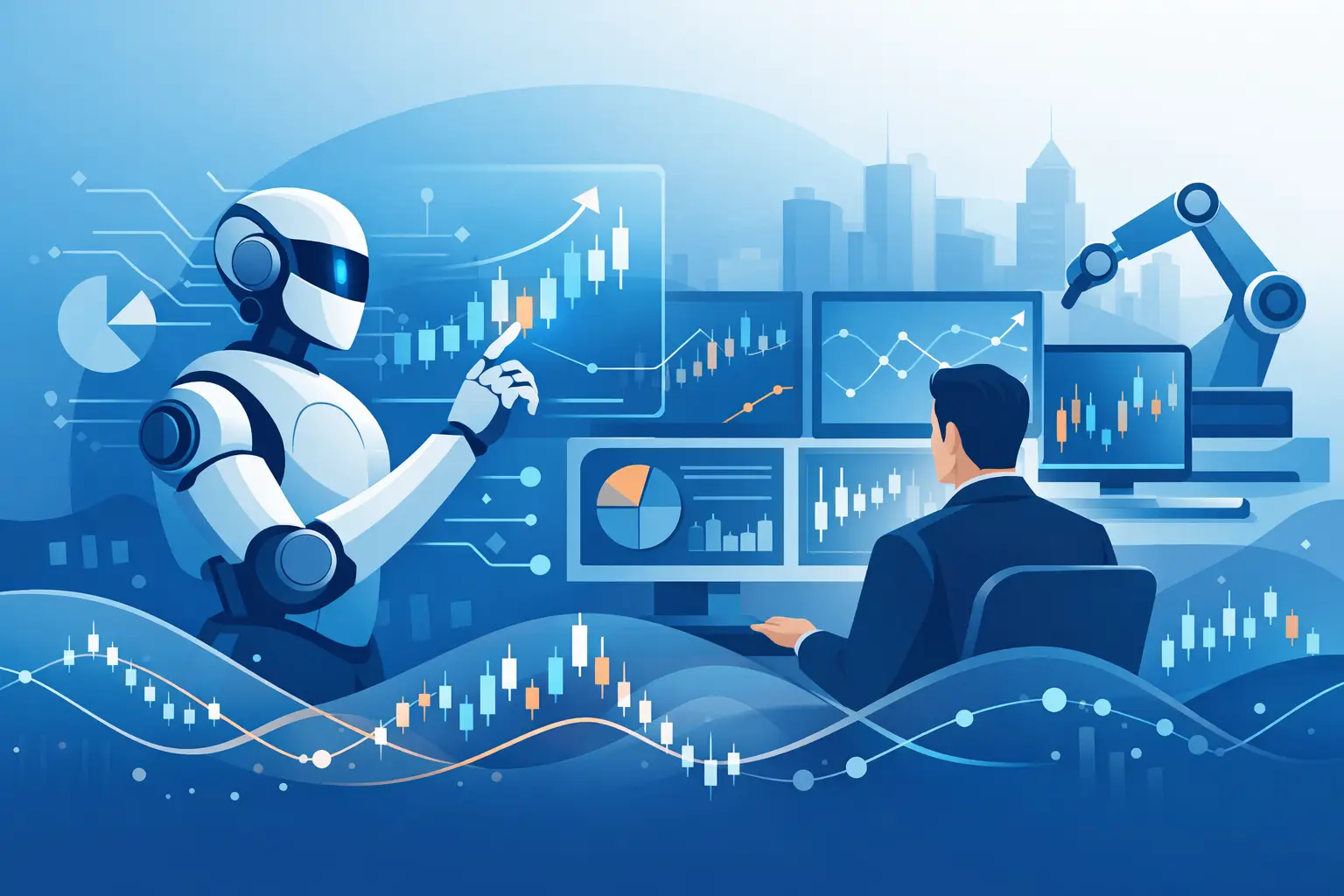
A fast strategy tester, a few optimization runs, and a dashboard full of clean equity curves can make automation look finished. It is not. The future of trading automation will not belong to traders who simply switch on a bot and hope for passive returns. It will belong to traders who can define clear rules, validate real market behavior, and supervise automated execution with the same discipline they bring to manual trading.
That matters because the market has changed. More participants now use automated logic in some form, from simple alert-based workflows to fully systematic execution. As a result, obvious inefficiencies tend to compress faster, regime shifts punish fragile models sooner, and the cost of bad assumptions shows up in live performance almost immediately. Automation is still a major advantage, but only when it is built on precision rather than convenience.
The future of trading automation is not fully hands-off
One of the most common misconceptions is that better automation means less trader involvement. In practice, the opposite is often true. Strong automation reduces emotional execution, speeds up decision-making, and enforces risk parameters, but it also demands more structured oversight.
Serious traders are moving away from the fantasy of total autopilot. They want systems that can scan, rank, alert, execute, and manage positions according to rules, while still allowing the trader to control context, risk exposure, and when to stand down. That is a more realistic model because markets are not static. Volatility changes. Liquidity shifts. Correlations tighten and break. News sensitivity expands and contracts.
The real edge is not removing the trader entirely. It is removing low-quality discretion while preserving high-quality supervision. In other words, automation handles repetition, and the trader handles judgment around conditions the model was not designed to solve.
Better data will matter more than more code
Over the next few years, the quality of a trading system will depend less on how complex it looks and more on the integrity of the inputs behind it. Traders often overestimate the value of additional indicators and underestimate the impact of cleaner market data, better session segmentation, more accurate volume interpretation, and realistic execution assumptions.
A strategy built on weak data can still backtest well. That is the problem. Slippage, spread expansion, delayed fills, rollover effects, and low-liquidity distortions can make a strategy appear stable until it goes live. The future of trading automation will reward traders who treat data preparation and market structure analysis as part of system development, not as an afterthought.
This is especially true across futures, forex, and crypto, where session behavior, order flow quality, and volatility regimes can differ sharply. A model that performs well during one period of stable trend conditions may fail when market internals weaken, when participation becomes uneven, or when intraday rotation replaces directional movement. Automation that ignores those differences is not advanced. It is just brittle.
Strategy logic will become more conditional
Simple rule sets still work, but simple does not mean generic. The next phase of automated trading will use more conditional logic tied to context. That could mean changing trade filters based on volatility state, reducing position size during unstable auction conditions, or blocking entries when internal market breadth does not confirm price.
This is where many retail systems fall short. They focus almost entirely on entry signals. Professional automation spends just as much time on no-trade filters, risk limits, and market qualification rules. A system that trades less but trades cleaner is often the stronger system.
Execution automation will outperform prediction-based automation
There is still too much attention on prediction. Traders ask whether AI, machine learning, or increasingly advanced models will forecast the next move better than traditional rule sets. Sometimes they will. Often they will not, at least not in a durable way that survives costs and regime change.
Execution is where automation has a clearer, more repeatable advantage. Machines are better at following exact instructions, managing partial exits, adjusting stops, reacting to predefined levels, and enforcing consistency without fatigue. They do not hesitate after two losses. They do not chase a late breakout because the last move looked strong. They do exactly what the model allows.
That is why the strongest use case for automation is not always signal discovery. It is execution quality. A trader may still define the market thesis manually, but automation can handle entry logic, scale-ins, stop movement, profit targets, and time-based exits with greater consistency than discretionary management.
For many active traders, that hybrid model will be the most practical path forward. It keeps strategy development grounded in real market observation while using automation where human performance usually degrades.
AI will help, but it will not replace rules-based systems
AI will absolutely influence the future of trading automation. It will improve research workflows, pattern classification, anomaly detection, and strategy review. It may help traders process more instruments, test more hypotheses, and identify relationships that are difficult to see manually.
But there is a difference between useful AI and trustworthy automation. Many AI-driven outputs are difficult to interpret, difficult to audit, and difficult to trust during drawdown. If a trader cannot explain why a model takes risk, when it stands aside, or what conditions invalidate its edge, then that model becomes harder to manage under pressure.
Rules-based systems still have a major advantage here. They are more transparent. They are easier to validate. They are easier to improve without breaking the entire framework. For serious traders, explainability matters because risk management matters.
The likely outcome is not AI replacing structured systems. It is AI supporting them. Traders will use AI-assisted research to refine filters, classify regimes, and accelerate analysis, while the live trading framework remains rules-based, testable, and constrained by clear risk parameters.
Risk controls will become the real product
As automation becomes more accessible, the competitive gap will shift away from basic signal generation and toward risk architecture. More traders can now create entries. Far fewer can build systems that control heat, correlation, overtrading, and exposure across multiple positions and instruments.
That is where the next level of automation is heading. Better daily loss limits. Better circuit breakers. Better session filters. Better controls around news windows, spread conditions, and declining market quality. These features are not glamorous, but they are often what separate a system that survives from one that looks impressive for three months.
In practical terms, traders should expect future automation tools to place more emphasis on portfolio-level risk, not just trade-level risk. A system that takes four valid signals at once can still create poor outcomes if those positions express the same market risk. Smarter automation will identify that concentration before the trader learns it the hard way.
Traders will need fewer systems and better process
Another shift is cultural. Traders have spent years collecting indicators, buying black-box systems, and searching for the strategy that removes uncertainty. The next stage is less about accumulating tools and more about integrating them into a repeatable process.
That process usually starts with a small number of tested conditions. Which market environments support your edge? Which internal readings confirm participation? Which volatility profiles improve execution? Which hours consistently degrade performance? Those questions create a framework. Automation then enforces it.
This is also where education and mentorship matter. Software alone does not teach a trader how to recognize when a model is out of sync with the market. It does not explain whether underperformance comes from normal variance, poor execution assumptions, or a genuine edge breakdown. Traders who combine automation with structured review will adapt faster than traders who treat every losing week as a reason to replace the system.
At TickSurfers, that is the practical view serious traders should keep in focus: tools matter, but the workflow around them matters more.
What traders should do now
The traders best positioned for the future are not waiting for fully autonomous profits. They are building cleaner rule sets, improving data quality, and tightening execution discipline today. They are reducing vague discretion, documenting market conditions, and using automation where consistency adds measurable value.
That may mean starting with semi-automated trade management instead of full auto-entry. It may mean using market internals, volume, volatility, or seasonality as qualification layers rather than as isolated signals. It may also mean abandoning strategies that look exciting in hindsight but cannot hold up under live conditions.
The future of trading automation will favor traders who think like risk managers first and system builders second. That approach is less flashy, but it is far more durable. If you want automation to improve real performance, build something you can explain, monitor, and trust when conditions get difficult. That is usually where a professional edge begins.