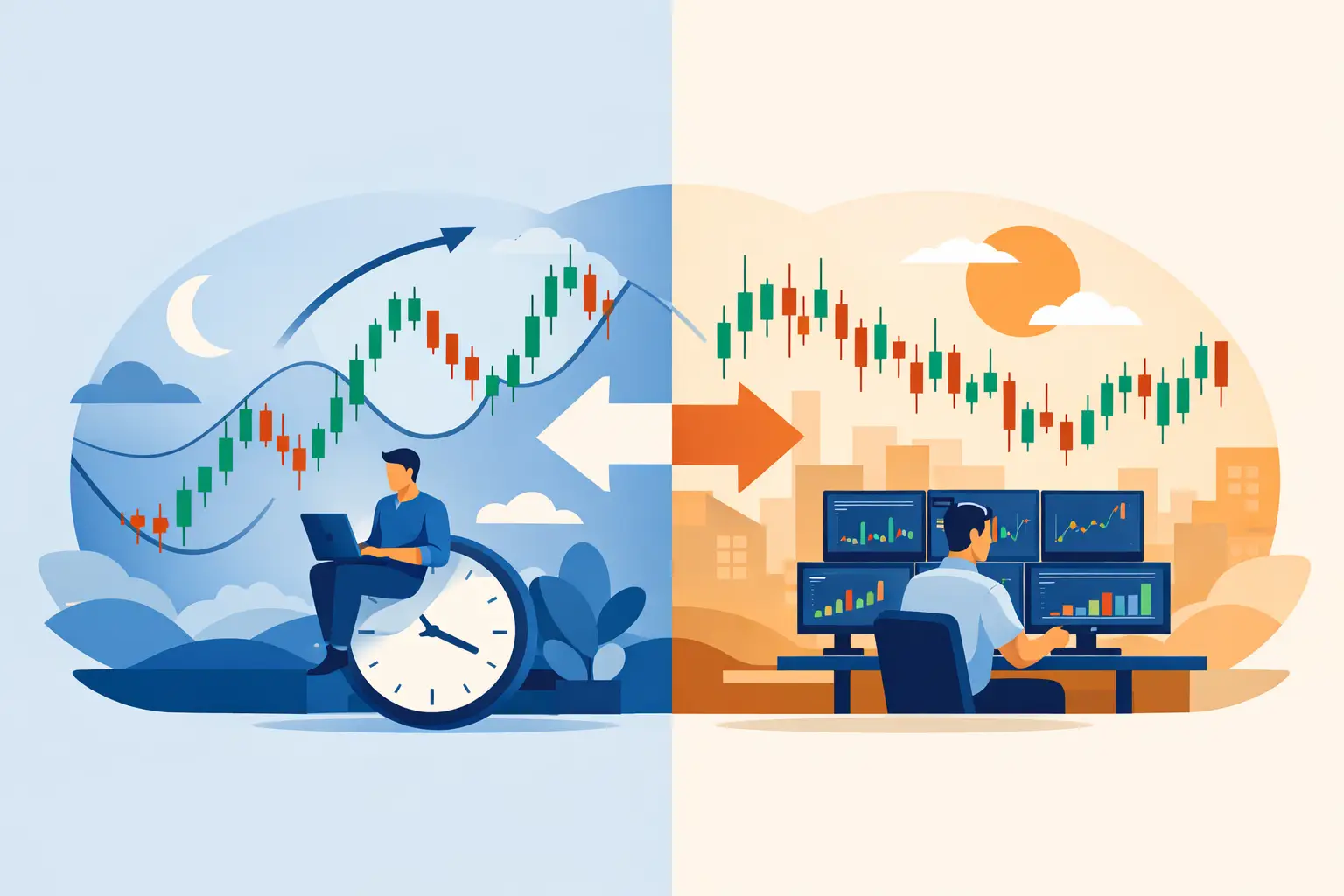
If you have ever taken a clean intraday setup only to watch it stall for hours, or held a strong swing position only to sit through overnight risk, you already know the real issue in swing trading vs day trading is not which style sounds better. It is which one matches your decision process, risk tolerance, and ability to execute with consistency.
Serious traders often treat this as a personality quiz. It is not. The better way to evaluate it is through structure. Time in trade, frequency of decisions, exposure to news, capital requirements, and psychological load all shape performance. A trading style should fit your edge, not your ego.
Swing trading vs day trading: the core difference
Day trading means opening and closing positions within the same session. The goal is to capture intraday movement while avoiding overnight exposure. Execution speed matters, and so does the ability to make repeated decisions under market pressure.
Swing trading means holding positions for more than one session, often for several days and sometimes longer. The objective is to capture a larger directional move rather than smaller intraday fluctuations. Precision still matters, but the rhythm is slower and the trade thesis usually depends on broader price structure.
That sounds simple, but the practical gap is wider than most traders expect. A day trader may take multiple trades in a morning and end the session flat. A swing trader may spend two days waiting for the right entry, then hold through earnings calendars, macro headlines, and overnight gaps. Both styles require discipline. They just stress different parts of the process.
Time commitment changes everything
For many traders, the first filter is not strategy. It is schedule.
Day trading demands attention during market hours. Even rules-based traders need to monitor conditions, confirm setups, manage exits, and stay aligned with session volatility. If your edge depends on the open, on market internals, or on momentum bursts around key levels, missing thirty minutes can mean missing the trade.
Swing trading is more flexible. Analysis can often be done before the session, after the close, or on a weekend. Orders can be planned around higher time frame levels with predefined entries, stops, and targets. That does not make swing trading easier, but it does make it more practical for traders who cannot sit in front of screens all day.
This is one of the first hard truths. If your lifestyle does not support your trading style, consistency will suffer before strategy even has a chance.
The risk profile is different, not lower
A common mistake is assuming swing trading is calmer and therefore safer. It is calmer in terms of screen time. It is not automatically lower risk.
Day traders avoid overnight exposure. That matters. A surprise policy headline, earnings miss, geopolitical event, or crypto liquidation wave can move price significantly outside regular market hours. By ending the day flat, the day trader eliminates that category of risk.
Swing traders accept overnight and multi-session exposure in exchange for the opportunity to capture larger directional moves. That means gaps can work for you or against you. A stop loss does not always guarantee the intended exit price if the market opens far beyond it.
On the other side, day traders face a different form of risk: repeated execution risk. More trades mean more chances to misread context, force setups, overtrade chop, or let one emotional decision affect the next three. Small mistakes compound quickly when trade frequency is high.
So the real comparison is not safe versus risky. It is gap risk versus execution density.
Swing trading vs day trading for capital efficiency
Capital use is another practical divider.
Day trading often requires more precise position sizing and tighter risk controls because stop distances are usually smaller and trade frequency is higher. In US equities, regulatory requirements like the pattern day trader rule can also shape what is realistic for smaller accounts. In futures and forex, leverage changes the equation, but it also increases the need for strict risk discipline.
Swing trading can be more forgiving from a time perspective, yet position sizing often needs to account for wider stops. If you are trading daily structure instead of a five-minute setup, the trade may need more room to work. That can reduce share size or contract size unless the account is large enough to absorb the broader risk.
In other words, neither style is inherently more capital efficient in every market. It depends on the instrument, volatility regime, and how tightly your system defines invalidation.
Trade frequency and data quality
Some traders are drawn to day trading because it offers more opportunity. That is partly true. More setups can mean more repetitions, faster feedback, and a quicker path to understanding whether a system actually has edge.
But more trades also create more noise. Intraday markets contain plenty of movement that looks actionable and is not. If your process is not rules-based, it becomes easy to confuse activity with opportunity.
Swing trading usually produces fewer trades, but they are often based on cleaner structure. Higher time frames can reduce market noise and make trend, momentum, and support-resistance behavior easier to evaluate. The trade-off is slower feedback. If you only take a handful of swing setups each month, it takes longer to build a meaningful sample size.
This is where serious traders separate themselves from hobbyists. The question is not how often you can trade. It is whether your trade frequency produces reliable data for review and improvement.
Psychological pressure hits in different ways
Day trading compresses stress into shorter windows. Decisions have to be made fast. You may need to act when volatility spikes, when liquidity shifts, or when the tape accelerates through a key level. That environment punishes hesitation, but it also punishes impulsiveness.
Swing trading spreads pressure over time. The setup may be clean, but once the trade is on, patience becomes the challenge. Can you hold through a normal pullback without abandoning the plan? Can you accept that a position may take days to develop? Can you avoid checking every intraday fluctuation and turning a swing trade into a badly managed day trade?
This is why mindset matters, but it should be framed correctly. The right question is not whether you are naturally patient or naturally aggressive. The right question is which set of psychological demands you can manage with objective rules.
Strategy design should match market behavior
A good trading style is built around how your setup behaves in live conditions.
If your edge comes from opening range breaks, volume surges, liquidity sweeps, market internals, or momentum continuation during active sessions, day trading is probably the cleaner fit. These setups often depend on intraday participation and lose their advantage when stretched across multiple sessions.
If your edge is based on trend continuation, pullbacks into higher time frame support, seasonality, multi-day mean reversion, or volatility expansion after consolidation, swing trading may offer better alignment. These patterns need time to mature.
This is also where tools matter. Traders using rules-based indicators, volume analysis, volatility filters, and structured confirmation can operate in either style, but the inputs must match the timeframe. A signal that is useful for intraday execution may be too reactive for swing positioning. A higher time frame trend filter may be excellent for swings but too slow for session-based trades.
At TickSurfers, that distinction matters because serious traders do better when their tools support the actual holding period and decision cycle they are working with.
Which traders tend to perform better with each style
Day trading tends to fit traders who can maintain focus during market hours, make repeated decisions without emotional drift, and follow execution rules with precision. It also fits traders who want to avoid overnight exposure and prefer ending each session with no open positions.
Swing trading tends to fit traders who prefer planning over constant monitoring, can tolerate overnight uncertainty, and are comfortable waiting for a setup to develop across several sessions. It often suits traders with other business or career demands who still want a structured market process.
Still, there is an important nuance here. Some traders choose swing trading because they think it will be less stressful, then struggle with gaps and patience. Others choose day trading because it feels more active, then discover that high frequency magnifies discipline problems. The style does not fix weak process. It exposes it.
How to decide without guessing
The cleanest way to choose between swing trading vs day trading is to test the decision like a system.
Start with your real availability, not your ideal schedule. Then define the instruments you want to trade, the hours you can consistently monitor, and the maximum risk you are willing to carry overnight. From there, review where your current setups actually perform best. If most of your clean signals resolve within the same session, forcing them into swing holds makes little sense. If your best trades require time to follow through, cutting them off intraday may be the real problem.
Then track the operational side. Measure how many decisions each style requires, how often slippage matters, how gaps affect outcomes, and where your execution breaks down. Traders often learn more from this process than from months of debating the label.
The best style is the one you can execute with repeatable discipline, under real conditions, using rules you can trust. If that ends up being swing trading, own it. If it ends up being day trading, own that too. Precision comes from alignment, not from trying to trade the way someone else does.
A useful closing standard is this: choose the style that lets you be objective most of the time, not the style that feels exciting in theory.