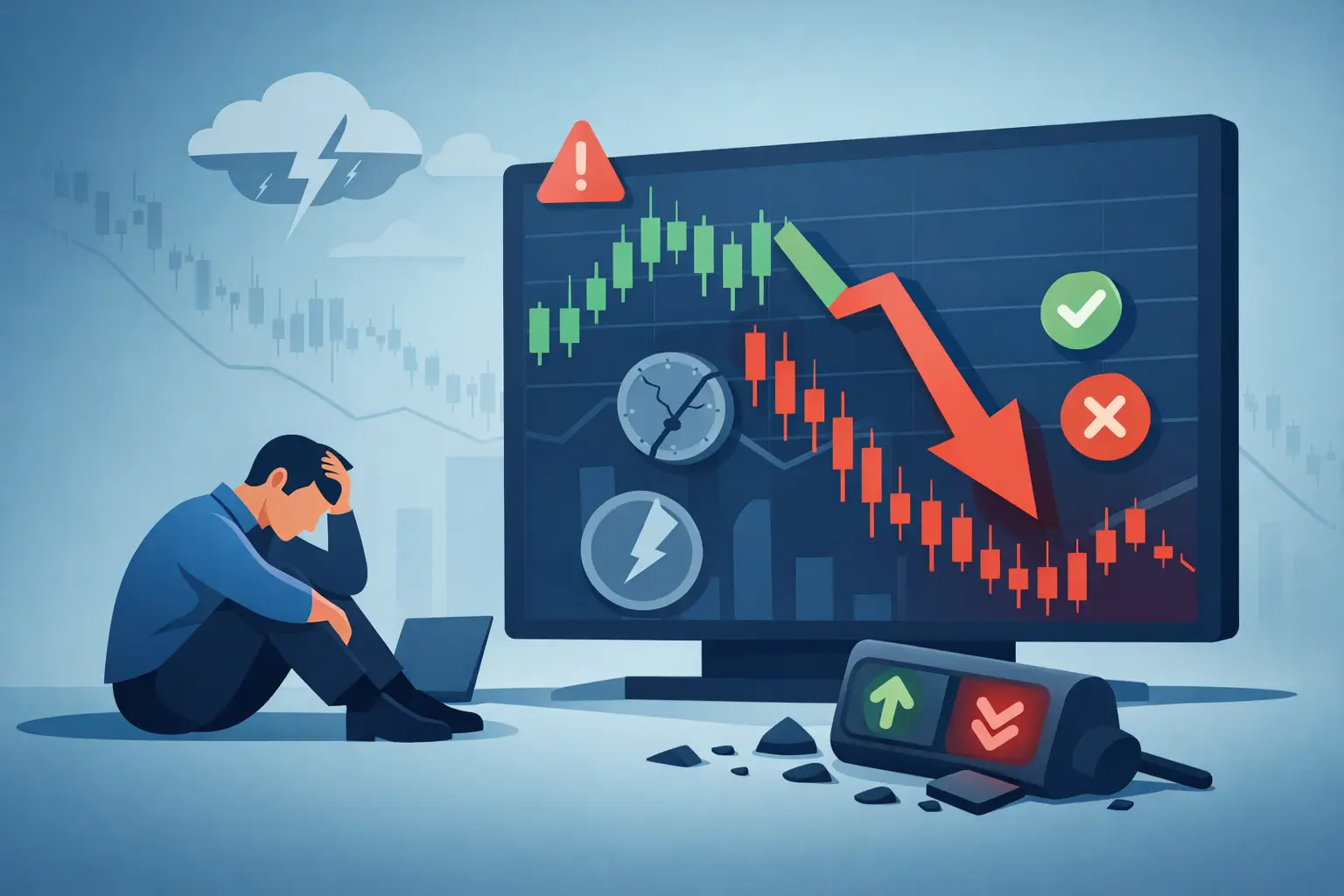
A signal prints, the setup looks clean, the entry triggers - and the trade still fails. If you have spent any real time in the market, you already know the question is not whether signals can fail, but why do trading signals fail even when the chart appears to match the rules.
That question matters because serious traders do not judge a signal by how good it looked in isolation. They judge it by whether it performs with enough consistency, under defined conditions, to support a repeatable edge. A signal is not a prediction. It is a structured expression of probability. And probability always lives inside context.
Why do trading signals fail in live markets?
Most signal failure starts with a basic misunderstanding. Traders often treat signals as standalone instructions, when in practice they are outputs from a model. Every model has assumptions about volatility, trend behavior, liquidity, time of day, participation, and market structure. When those assumptions stop matching current conditions, the signal can remain technically correct while becoming practically weak.
This is why a strategy that worked well in a clean trend can suddenly underperform in rotational trade. It is also why a breakout signal can fail repeatedly in an environment dominated by mean reversion. The issue is not always that the indicator is broken. Often, the market regime changed and the trader did not adjust.
Another common problem is sample size. Traders tend to overreact to a few losing signals and call the system unreliable, or worse, trust a handful of winners and assume they found a durable edge. Neither approach is professional. A signal has to be evaluated across enough occurrences, in specific market conditions, with consistent execution. Without that, what looks like failure may just be normal distribution.
A signal is only as good as the conditions behind it
Signals fail most often when traders separate entry logic from market context. That is where many retail workflows break down. They focus on the trigger but ignore the environment.
A momentum signal in a low-volume lunch session does not carry the same weight as the same signal during a period of expanding participation. A reversal signal into higher-timeframe resistance is not the same as a reversal signal in open space. A long setup in a strong uptrend is different from a long setup inside a choppy, two-sided range.
This is the difference between using a signal mechanically and using it professionally. Rules matter, but rules have to include condition filters. Trend strength, volatility expansion, relative volume, session timing, and location on the chart all affect whether a setup has room to work.
When traders ask why do trading signals fail, the answer is often simple: the signal was taken outside the environment it was designed for.
Market regime mismatch
Every rules-based system has a regime where it performs best and a regime where it struggles. Trend-following signals typically lose efficiency in sideways markets. Mean-reversion signals often get run over during directional expansion. Volatility breakout models can degrade badly when ranges compress and false breaks become common.
The mistake is assuming one signal logic should work equally well across all conditions. It will not. Strong trading performance usually comes from matching the tool to the market state, not forcing the same tool into every chart.
Timeframe confusion
A valid signal on a five-minute chart can be low quality if it is trading directly against the structure on the hourly or daily chart. The reverse is also true. A trader may get shaken out on a lower timeframe even though the higher-timeframe premise remains intact.
Many failed trades are not signal failures in the pure sense. They are timeframe conflicts. If your entry model, stop placement, and holding expectation are built on different chart horizons, results will be inconsistent no matter how clean the signal appears.
Execution turns good signals into bad trades
A signal can be statistically sound and still produce poor outcomes if execution is weak. This is where theory and live performance separate quickly.
Slippage changes entry quality. Late execution changes risk-reward. Chasing after confirmation often means buying after the move is already extended or shorting after the flush has already happened. In fast markets, a few ticks or cents matter more than most traders admit.
Then there is position sizing. Traders often call a signal bad when the real issue is that they sized the trade too aggressively for the instrument's volatility. A normal drawdown feels like failure when risk is out of line. The setup did not necessarily break. Risk management did.
Stops create another distortion. If stops are too tight relative to the instrument's normal movement, even good signals will show a high failure rate in live conditions. If stops are too wide, the win rate may look acceptable but the expectancy can deteriorate. That balance has to come from testing, not preference.
Strategy drift
Once a trader takes a few losses, the temptation is to modify execution on the fly. They skip the next signal, reduce size at the wrong moment, widen a stop, take profits early, or add a discretionary filter that was never tested.
At that point, they are no longer evaluating the system. They are evaluating a changing version of themselves. Many traders think the signal failed when what actually failed was process discipline.
Some signals fail because the logic is weak from the start
Not every signal deserves defending. Some fail because they are built on fragile assumptions, overfit backtests, or simplistic indicator logic that looks precise but has no durable edge.
This is common with tools that are optimized too tightly to historical data. A developer can tune parameters until a chart looks impressive, but that does not mean the signal will survive live markets. If the model depends on a narrow set of historical quirks, it will usually degrade when conditions shift.
There is also a difference between correlation and causation. An indicator may appear to identify turning points in one period, but if the logic is not tied to a repeatable market behavior, that relationship can disappear quickly. Serious traders need to know what market behavior a signal is measuring, not just what line crossed what level.
That is one reason rules-based traders gravitate toward tools grounded in participation, volume, volatility, structure, and trend conditions. The more directly a signal maps to actual market behavior, the more useful it tends to be.
The trader's expectations are often the hidden problem
A lot of signal disappointment comes from unrealistic expectations. Traders want high win rates, small drawdowns, early entries, and large reward multiples all at once. Real systems involve trade-offs.
A breakout model may have a lower win rate but larger average winners. A mean-reversion model may win more often but suffer sharp losses when conditions trend hard. A highly selective signal may improve quality but reduce opportunity. There is no free version of edge.
This matters because many traders abandon a valid system during its normal losing phase. They expected the signal to remove uncertainty. It never could. The objective is not to eliminate failed trades. The objective is to build a process where failures are planned for, measured, and controlled.
How professionals reduce signal failure
Professional traders do not look for perfect signals. They build signal frameworks. That means defining not just the trigger, but the conditions where the trigger has an advantage.
The best workflows usually include a small set of aligned variables: market regime, higher-timeframe bias, volatility state, participation, entry rule, stop logic, and exit logic. This creates a complete decision model instead of a single-point trigger.
It also helps to track signal performance by condition set. Do signals perform better during trend days than balanced sessions? Does the setup improve when relative volume is above average? Does it weaken during midday trade? Once performance is segmented, weak spots become easier to identify.
For traders using rules-based tools, this is where real improvement happens. Not by hunting for more signals, but by understanding which signals deserve capital in which conditions. That is the standard serious traders should hold.
At TickSurfers, that is the philosophy behind structured market tools and education: the signal is only one part of the edge. The edge comes from using objective rules inside the right environment, with disciplined execution and clear risk control.
A better question than why do trading signals fail
A more useful question is this: under what conditions does this signal perform poorly, and can those conditions be filtered, sized differently, or avoided?
That shift changes everything. It moves the trader away from frustration and toward diagnosis. It replaces opinion with testing. And it turns a failed trade from a personal mistake into usable data.
Markets will keep changing. No signal will stay strong in every regime, on every instrument, and in every session. But traders who understand the behavior behind the signal, the conditions that support it, and the execution required to realize it put themselves in a much stronger position.
A failed signal is not always a warning to abandon your system. Sometimes it is the market telling you to refine your rules, tighten your filters, and trade with more precision.