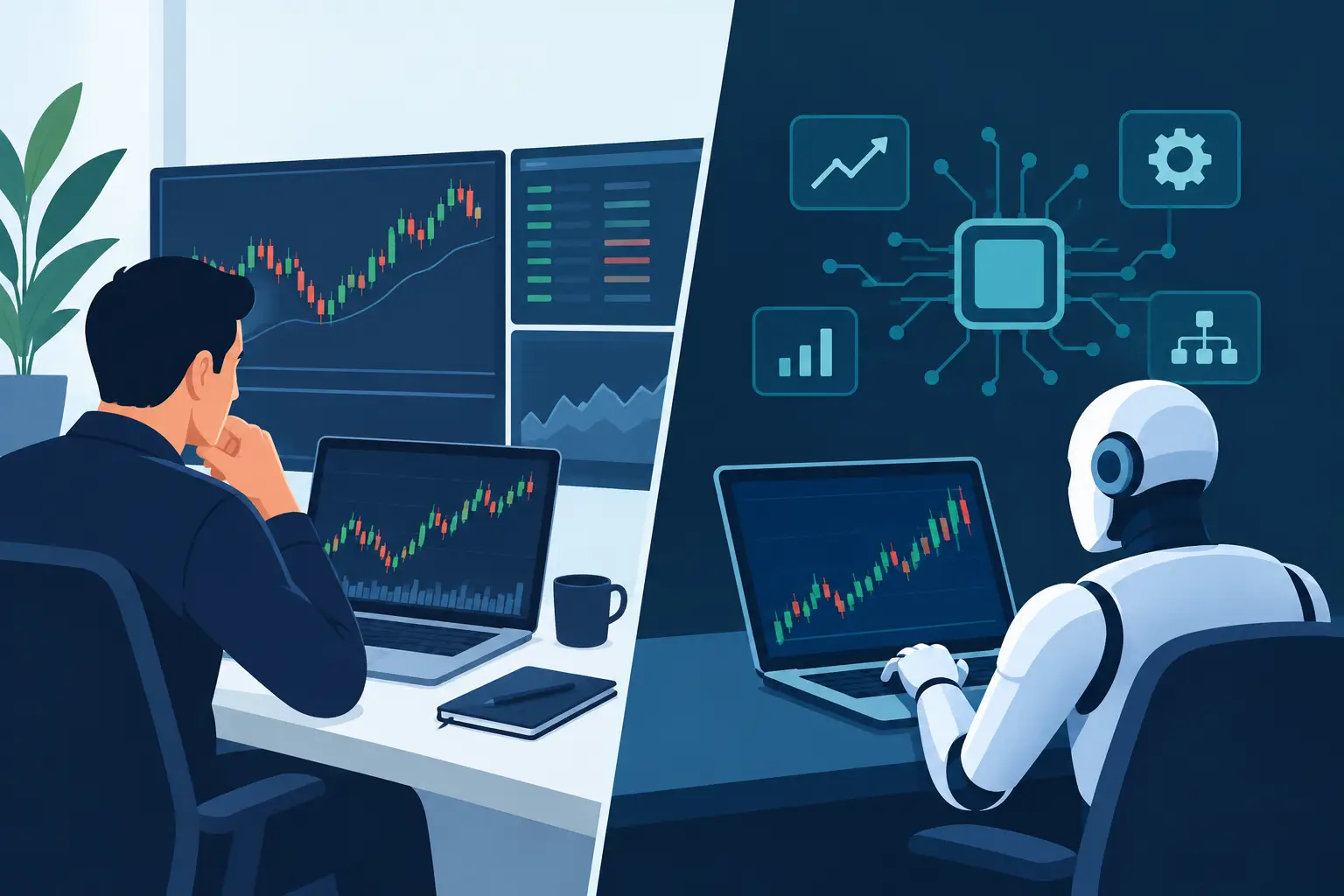
A futures trader sees an opening-range breakout developing just after the cash open. Volume is expanding, market internals confirm participation, and the setup matches the plan. The question is not whether the chart is interesting. It is whether the trader can execute the rules without hesitation, avoid taking profits too early, and manage risk exactly as defined.
That is where manual versus algo trading becomes a practical decision rather than a philosophical one. Both approaches can support high-probability trades. Both can also fail when the underlying rules are weak, risk controls are vague, or the trader expects a tool to compensate for a lack of process.
For serious traders, the better question is: which parts of your trading process should remain discretionary, and which parts should be made objective and repeatable?
Manual Versus Algo Trading Starts With the Edge
Manual trading means a person evaluates market information and places, manages, or exits trades directly. An algorithmic approach uses programmed conditions to generate signals, execute orders, manage positions, or perform a combination of those tasks. The distinction is not always absolute. Many disciplined traders use a hybrid workflow: automation identifies qualifying conditions, while the trader retains approval over entry and management.
Neither method creates an edge by itself. The edge comes from a defined relationship between market conditions, entry logic, risk, and expected outcome. If a strategy has no demonstrated expectancy, automating it simply allows a trader to lose money with greater speed and consistency. If a trader cannot state the conditions for a setup clearly enough to test them, discretion may be covering uncertainty rather than adding skill.
The productive path is to identify which decisions are genuinely improved by human judgment and which decisions are repeatedly damaged by emotion, delay, or inconsistency.
Where Manual Trading Has an Advantage
Manual trading is often strongest when market context matters more than a fixed signal. A skilled trader may recognize that a familiar pattern is forming into major higher-timeframe resistance, during an abnormal volatility event, or after a news-driven liquidity shift. Those factors can change the quality of a setup even when an indicator looks similar to prior opportunities.
This flexibility matters across stocks, futures, FOREX, commodities, and crypto. Market behavior changes. Session structure changes. Liquidity changes. A trader who understands order flow, volatility, volume, and market internals can decide when a valid signal deserves reduced size, a wider target, or no trade at all.
Manual execution also allows traders to adapt when data is incomplete or conditions are unusual. An algorithm may be built to buy a pullback in a strong trend. A discretionary trader can recognize that the pullback is occurring after an exhausted extension, directly beneath a key supply zone, or during a period when correlation between related markets has broken down.
The drawback is clear: flexibility can become inconsistency. Traders often call a decision “discretion” when it was actually fear, hope, boredom, or an impulse to recover a loss. Without written rules and trade review, manual trading makes it easy to rewrite the rationale after the fact.
Where Algo Trading Has an Advantage
Algorithmic trading is built for repeatability. A rules-based system does not become impatient after three losing trades. It does not skip the fourth valid setup because the previous trade failed. It does not widen a stop because it dislikes taking a loss.
That consistency is especially valuable when a strategy depends on quick execution, frequent scanning, or disciplined management across multiple instruments. A system can monitor defined conditions across a watchlist, calculate position size from preset risk limits, and act immediately when the setup qualifies. For active traders, that can reduce the gap between what the plan says and what actually happens in the account.
Automation also creates a cleaner research environment. When entry, exit, sizing, and filters are explicit, the strategy can be tested across different market regimes. Traders can measure win rate, average gain, average loss, drawdown, expectancy, hold time, and sensitivity to costs. That does not guarantee future performance, but it replaces opinion with evidence.
There is another benefit: algorithms can enforce operational discipline. A system can stop accepting new trades after a daily loss limit, avoid low-liquidity periods, or reduce risk after a defined drawdown. Those controls are often ignored precisely when a manual trader needs them most.
The Limits of Full Automation
A backtest is not a trading business. It is a research result based on assumptions about fills, spreads, commissions, slippage, liquidity, and market behavior. The more active the strategy, the more those assumptions matter. A fast intraday futures system may look attractive before realistic execution costs are included and far less compelling afterward.
Overfitting is another serious risk. If a system has been optimized around every past turn, breakout, and pullback, it may be fitting historical noise rather than capturing a durable market tendency. More parameters do not necessarily create more precision. Often, they create a strategy that is difficult to understand and fragile in live conditions.
Full automation can also make traders complacent. Markets evolve, volatility regimes shift, and structural events occur. Systems require monitoring, validation, and occasional retirement. Turning on a strategy and assuming it will behave as it did in testing is not disciplined automation. It is unmanaged risk.
For that reason, automation should be treated as a controlled operating process. Define when a strategy is allowed to trade, how performance is reviewed, what drawdown triggers reduced size or suspension, and who is responsible for intervention when market conditions become abnormal.
A Practical Hybrid Model for Active Traders
For many active market participants, the most effective answer is not manual or automated trading. It is selective automation around a clear discretionary framework.
Start by separating your process into four functions: market selection, setup detection, trade execution, and position management. Then ask where mistakes occur most often. A trader may be strong at reading a market’s broader condition but poor at waiting for a precise entry. In that case, an alert or rules-based signal can improve timing without removing the trader’s contextual judgment.
Another trader may have a fully defined entry but repeatedly violates profit targets and stop levels. Automated brackets or systematic exits may be the appropriate solution. A trader managing several correlated markets may benefit from automated scanning, while still deciding which signals deserve capital based on daily structure and risk exposure.
This hybrid model has a professional advantage: it keeps humans focused on decisions that require judgment while assigning repetitive, measurable tasks to rules. The objective is not to eliminate discretion. It is to eliminate unproductive discretion.
Build the Decision Around Your Trading Style
Day traders often gain the most from automation in signal detection, alerts, order entry, and risk controls. Fast markets punish delayed action, while a structured system can ensure that valid setups are identified and managed consistently.
Swing traders may keep more discretion because broader technical context, event risk, sector leadership, and changing volatility can influence holding decisions. Even so, quantitative filters for trend, volume, relative strength, seasonality, or volatility can significantly improve selection quality.
Systems traders need the strongest research discipline. Their work should begin with a testable hypothesis, not an indicator setting that happened to work on one chart. They should test across instruments and market environments, include realistic costs, use out-of-sample data, and start live deployment at conservative risk.
If your process is still developing, do not rush to automate every rule. First, trade the concept with enough structure to understand why it works, when it fails, and what conditions matter. Then automate the repetitive components that have proven stable.
A free charting platform can be a practical place to do that work. Use it to define market conditions, observe signals in context, document execution rules, and determine whether your decisions are repeatable before placing greater trust in automation.
The Standard Is Consistency, Not Technology
Manual versus algo trading is not a contest between intuition and code. It is a decision about how to express a proven edge with the least amount of execution error. Manual traders need objective rules strong enough to prevent emotion from taking control. Algorithmic traders need oversight strong enough to prevent a model from operating beyond its assumptions.
The most useful next step is simple: review your last 20 trades and identify every decision that was not made according to plan. If the same failure appears repeatedly, it may be a candidate for a rule, an alert, or automation. Better trading rarely begins with more activity. It begins when the process becomes precise enough to repeat.