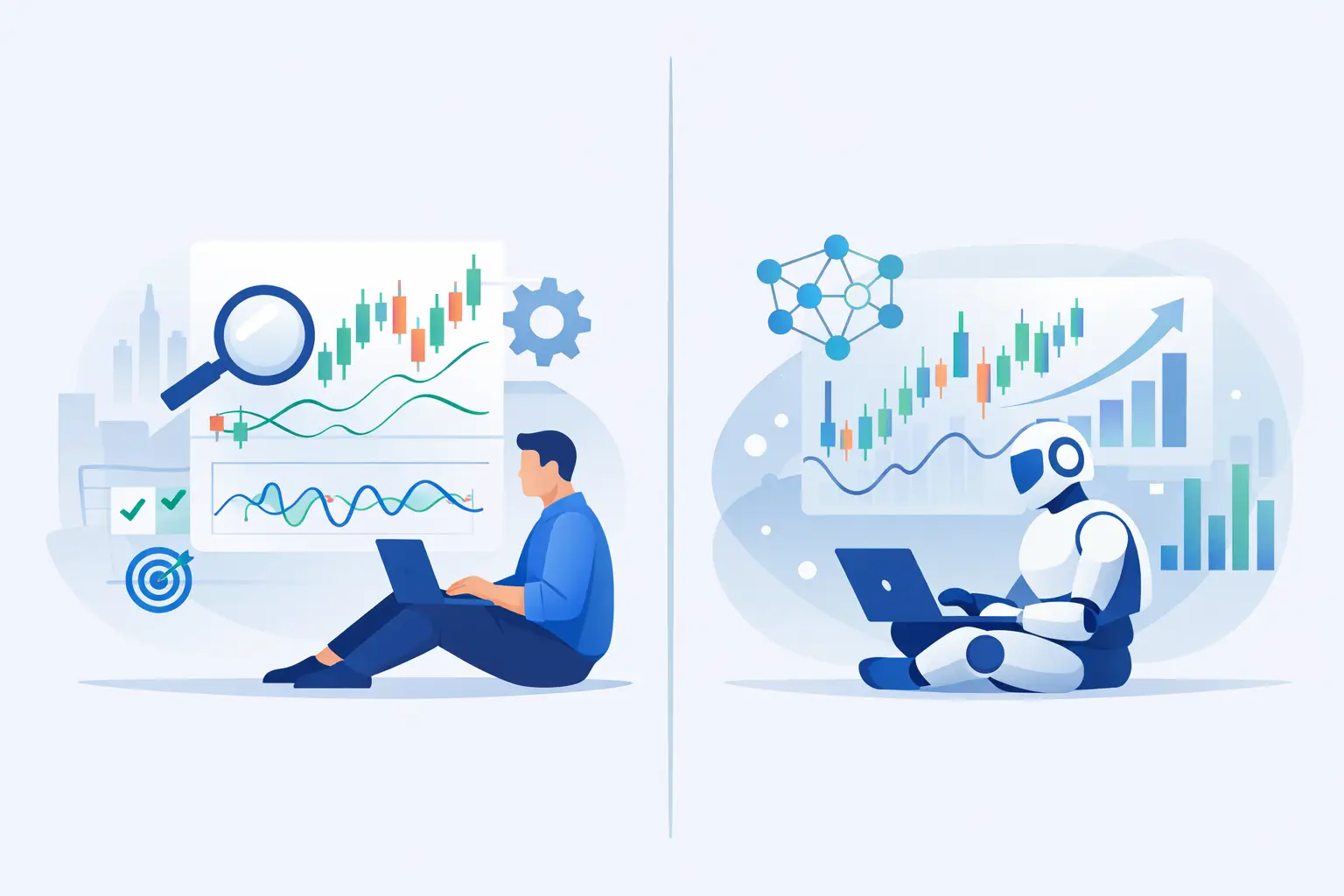
A trader marks up a chart, sees momentum building, and takes the setup. Another trader runs the same market through fixed entry, exit, and risk rules, with orders triggered automatically. Both may claim to be systematic. They are not doing the same job. That gap is exactly why trading indicators vs algorithms is a practical question, not just a technical one.
Serious traders need to know whether they are using a tool for analysis or a system for execution. If you blur that line, you create confusion around edge, testing, and accountability. An indicator can improve decision quality. An algorithm can enforce decision quality. Those are related, but they are not interchangeable.
Trading indicators vs algorithms: the real difference
A trading indicator is an analytical tool. It processes market data and presents information in a usable form, whether that means trend direction, momentum shifts, volatility expansion, volume imbalance, or market internals. An indicator helps you interpret conditions. It does not, by itself, define a complete trading business process.
An algorithm is a rule set that takes inputs and produces actions. In trading, that usually means the logic specifies when to enter, when to exit, how much to trade, and how to manage risk. Some algorithms are fully automated. Others are semi-automated and still require trader confirmation. The key point is that an algorithm is not just showing information. It is operationalizing decisions.
This distinction matters because many traders say they have a system when they really have a chart template. A chart with five indicators may feel structured, but unless the rules are specific enough to test and repeat, it remains discretionary. Discretion is not automatically bad. It is just different from a rules-based algorithmic approach.
Where indicators fit in a professional trading process
Indicators are often the fastest way to move from random chart reading to structured analysis. They reduce noise, highlight repeatable conditions, and help traders focus on what matters most in their market. A good indicator can show trend context, reveal exhaustion, measure volatility, or identify volume-driven interest that is not obvious from price alone.
For active traders, that matters because markets do not pay for opinions. They pay for timing, risk control, and consistency. Indicators help build a framework for those decisions. A momentum indicator may keep you from fading strength too early. A volume tool may confirm whether a breakout has participation behind it. A volatility measure may tell you whether your target size is realistic for current conditions.
But indicators have limits. They simplify data, and any simplification leaves something out. Most indicators also lag to some degree because they are derived from price, volume, or both. Even leading-style tools are still interpretations of data, not predictions. If a trader expects certainty from an indicator, the problem is not the tool. The problem is the expectation.
That is why professional use of indicators depends on rules. An indicator should answer a specific question. Is trend aligned across timeframes? Is momentum accelerating or weakening? Is volatility compressing ahead of expansion? Once you know what the tool is supposed to measure, you can judge whether it actually improves your decision process.
What algorithms do better than indicators alone
Algorithms excel where human inconsistency becomes expensive. They apply the same logic every time, without hesitation, boredom, or impulse. For traders who already know their setups but struggle with execution, that alone can produce a measurable improvement.
A well-built algorithm also forces clarity. You cannot code vague logic like “this looks strong” or “the market feels heavy.” You need explicit conditions. That requirement exposes weak assumptions fast. If the rules cannot be defined, they cannot be tested. If they cannot be tested, confidence in live trading usually collapses the moment drawdown appears.
Algorithms are also more useful when the strategy depends on speed, multi-market scanning, or strict order handling. If you are managing several instruments, watching correlated markets, or trading shorter-term patterns, manual execution can become a bottleneck. An algorithm can monitor conditions continuously and react without delay.
Still, automation is not a shortcut to edge. A bad discretionary process does not become good because it is coded. In fact, weak logic often fails faster in algorithmic form because every flaw is applied consistently. That is useful from a testing standpoint, but expensive if traders skip validation.
Trading indicators vs algorithms in real-world use
In practice, most serious traders do not choose one and reject the other. They combine them based on experience, timeframe, and strategy design.
A day trader may use indicators to define context and then execute manually. For example, trend, volume, and volatility tools may identify a high-probability environment, while the trader still controls timing around key levels. That approach keeps the trader engaged where discretion adds value but removes a lot of noise from the process.
A systems trader may take those same concepts and convert them into an algorithm. Trend becomes a filter. Volume becomes a confirmation condition. Volatility becomes a position-sizing or stop-placement variable. Now the indicator is not the strategy. It is one input inside a broader decision engine.
This is where many traders improve. They stop asking whether indicators or algorithms are better in the abstract and start asking a more useful question: which parts of my process should be discretionary, and which should be rules-based?
When indicators are the better choice
Indicators are often the better fit when the trader is still developing pattern recognition, refining setups, or trading conditions where context matters more than speed. They are also useful when market behavior changes enough that a human can adapt faster than a rigid model.
For example, during unusual volatility or event-driven sessions, a trader may benefit from reading price behavior with the help of structured tools rather than handing full control to automation. Indicators can support judgment without pretending to replace it.
They are also ideal for traders who need decision support rather than full automation. If the issue is inconsistent analysis, indicators can solve that. If the issue is emotional execution, indicators alone may not be enough.
When algorithms make more sense
Algorithms make sense when the edge is clearly defined, repeatable, and measurable. They are especially valuable when the setup occurs often, requires fast response, or suffers when human judgment interferes. If you have already proven that a strategy performs best when rules are followed exactly, automation becomes a logical next step.
They also fit traders who want scale. Monitoring one chart manually is manageable. Monitoring a basket of futures, forex pairs, or crypto markets with consistent logic is a different problem. Algorithms solve that more efficiently than screen-watching.
But there is a trade-off. The more structured the algorithm, the more dependent it becomes on the quality of the model and the conditions it was built for. Markets evolve. A system that performs well in one regime can degrade in another. That does not mean algorithms fail. It means professional traders monitor, review, and adjust rather than assuming the code is permanent truth.
The biggest mistake traders make
The biggest mistake is treating indicators and algorithms as identity choices instead of process tools. Traders say, “I am a discretionary trader,” or “I am an algo trader,” as if that settles the issue. It does not. The real issue is whether the process produces objective, repeatable decisions.
If indicators help you define high-probability trades with consistency, they are doing their job. If an algorithm helps you execute a validated edge with discipline, it is doing its job. Problems start when traders expect indicators to act like complete systems or expect algorithms to fix strategy flaws that were never solved in the first place.
That is why the strongest workflows are usually layered. Context can come from market internals, volume, seasonality, or volatility tools. Entry logic can be rules-based. Risk can be standardized. Execution can remain manual or become automated depending on the trader’s strengths. This is the kind of precision-driven structure serious traders should be building toward.
At TickSurfers, that is the practical bridge many traders need - moving from chart-based signals to rules-based systems without losing sight of market context.
A better way to think about the decision
Instead of asking trading indicators vs algorithms as if one must replace the other, ask where discretion is helping and where it is hurting. If your analysis is messy, start with better indicators and tighter rules. If your analysis is solid but execution breaks down, algorithmic support may be the next step.
The goal is not to sound more advanced. The goal is to trade with more precision. Tools should reduce ambiguity, support risk control, and make your edge easier to repeat. If a tool does not do that, it is not improving your process, no matter how sophisticated it looks.
Good trading usually gets better when decisions become more objective. Whether that starts with an indicator or ends in an algorithm depends on the trader, the market, and the rules you are willing to follow when money is on the line.